
Source: China Fund News Reporter Guo Wenjun, Ye Shijie
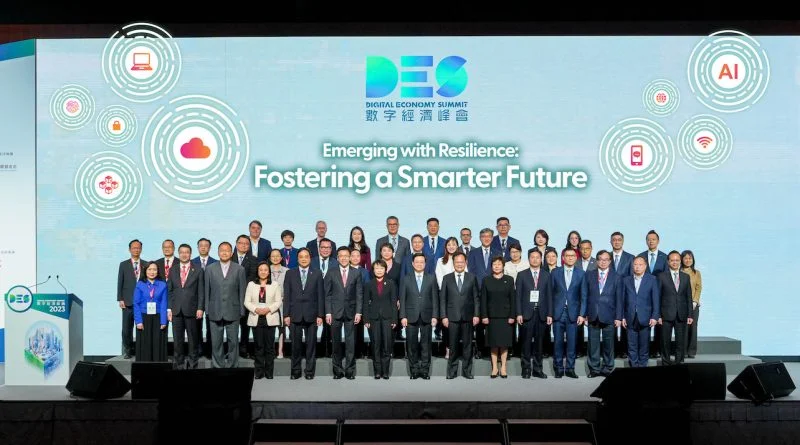
The 2023 Digital Economy Summit held at the Hong Kong Convention and Exhibition Centre from April 13 to April 14 is a major event in the field of technological innovation and development. The event received enthusiastic responses from all over the world, attracting about 4,000 registrations from dozens of countries and regions. During the summit, Sun Dong, Secretary for Innovation, Technology and Industry Bureau of the HKSAR Government, and Tony Wong, Acting Government Chief Information Officer, were interviewed by reporters from China Fund News.
Sun Dong said: "We have seen the enthusiastic expectation from all over the world for the mainland and Hong Kong to develop scientific and technological innovation to promote high-quality development. We also very much hope that Hong Kong's scientific and technological innovation development can have greater moves in the future, and at the same time further strengthen cooperation with the mainland, better integrate into the overall national development, and contribute to the country's high-quality development."
Hong Kong is Giving Full Play to International Advantages to Fully Integrate into the Overall National Development
Q: What role do you think Hong Kong can play in promoting the development of the digital economy in China and even the world?
Sun Dong: At present, the role of the digital economy is becoming increasingly strengthened, and it may become the main battlefield of future high-tech competition. Under the strategy of building a Digital China, Hong Kong must first integrate into the overall national development and the development of the national digital economy to contribute to the high-quality development of the country. In addition, I believe that the proportion of the digital economy in the national GDP will become larger and larger in the future, and the digital economy can also be well combined with the real economy, such as in artificial intelligence and the Internet of Things. These can be quickly transformed into substantial economic development. As far as Hong Kong is concerned, in addition to the above roles, as an international financial center, Hong Kong has a more special role in helping China's digital economy development. Hong Kong should use its international environment and advantages to attract some advanced talents and technologies related to the digital economy from home and abroad to play a greater advantage.
Hong Kong Wants to Build an International Innovation and Technology Center. How Can Hong Kong and the Mainland Cooperate and Develop together to Achieve a Win-Win Situation?
Sun Dong: First of all, we strongly encourage Hong Kong start-ups to develop in the mainland. Hong Kong is the country's Hong Kong. After start-ups with strong original innovation capabilities are incubated in Hong Kong, the mainland has greater room for development in terms of market application, large-scale manufacturing of new products, and attraction and demand for various talents. Therefore, it is very important for Hong Kong start-ups to develop in the mainland. In fact, some of our scientific research achievements and sci-tech innovation enterprises in the past have developed very well in the mainland, which is also an important part of Hong Kong's integration into the overall national development and contribution to the country. On the other hand, since Hong Kong is establishing an international innovation and technology center, we also hope that more and more start-ups are willing to enter Hong Kong. To build an international sci-tech innovation center, the SAR government has issued a series of preferential policies, including the establishment of the Hong Kong Investment Corporation Limited to manage the Hong Kong Growth Portfolio, the Greater Bay Area Investment Fund, the Strategic Tech Fund set up under the Future Fund, and the newly established Co-Investment Fund. This means that for some start-ups with good development prospects, the SAR government is willing to provide certain financial support.
Is Hong Kong Communicating with Mainland Cities? regarding Smart Cities, How Should Hong Kong's Advantages and Influence be Expanded to the Entire Greater Bay Area and Even the Whole Country in the Future?
Tony Wong: In fact, in terms of smart cities, the cooperation between the SAR government and Guangdong Province has a history of more than ten years, and different departments of Guangdong Province have also become "good partners" in cooperation. At the end of March this year, Chief Executive John Lee led a delegation to visit several cities in Guangdong Province and signed a series of cooperation agreements, including the "Co-operation Agreement between Guangdong and Hong Kong on Co-developing a Smart City Cluster", aimied at strengthening exchanges between the two sides, accelerating the pace of digital economy and smart city development on both sides, and jointly promoting the construction of the Guangdong-Hong Kong-Macau smart city cluster. This includes multiple projects, such as data application, cross-boundary data, and data sharing. In addition, in terms of cross-boundary public services, we will also have closer and more tacit connectivity with the Guangdong Provincial Government in terms of technology and systems. In fact, very many Hong Kong residents live and develop in the Guangdong-Hong Kong-Macau Greater Bay Area, and if cross-boundary government services continue to be optimized, it will be a huge convenience for the people.
What are the Advantages of Shanghai and Hong Kong in the Field of Innovation and Technology? In Which Fields Can Cooperation be Carried Out in the Future?
Sun Dong: Shanghai, Beijing, and the Guangdong-Hong Kong-Macau Greater Bay Area are the three international innovation and technology centers that the country wants to build. In fact, over the past period of time, Hong Kong and Shanghai have had strong interactions. Both cities are highly internationalized cities in our country and have high scientific research strength. Shanghai is more prominent in advanced industrialization, while Hong Kong has the advantage of being an international financial center. China is very large, and Shanghai and Hong Kong are located in different geographical regions. Shanghai radiates to the middle and lower reaches of the Yangtze River, while Hong Kong is located in South China. The country needs different high-tech development regions and spaces.
Recently, Hong Kong and Shanghai also have many collaborations in the field of innovation and technology. For example, at the end of March this year, Shanghai Lingang Group and Hong Kong Cyberport signed a memorandum of cooperation, and the two sides will establish a comprehensive strategic cooperative relationship in the form of "sister parks". As far as I know, quite a few enterprises in both parks are willing to go to the other park for development.
Hong Kong Has Obvious Advantages in Developing Digital Economy and Innovation and Technology
In the Recently Published "2023 Smart City Index" by the World Competitiveness Center (WCC) under the International Institute for Management Development (IMD) in Lausanne, Switzerland, Hong Kong's Ranking Has risen significantly. What Do You Think are Hong Kong's Advantages in Developing a Smart City?
Sun Dong: In terms of advantages, as an international financial center, Hong Kong has an international environment, which facilitates attracting talents from home and abroad and applying advanced technologies from all over the world for technical exchanges. Moreover, Hong Kong has good basic scientific research strength. In addition, the current HKSAR Government attaches great importance to the development of the digital economy and has clearly proposed the development of smart cities in the "Hong Kong Innovation and Technology Development Blueprint". Furthermore, I believe that regarding Hong Kong establishing an international innovation and technology center, in addition to serving the needs of the country, integrating into the overall national development, and high-quality development, there is another important task, which is to improve citizens' lives through technological innovation. What citizens feel most easily is the development related to smart cities, which is also why the SAR government focuses on developing a series of projects such as smart city, smart mobility, smart healthcare, and smart living. I think many mainland cities have done very well in this regard, and it is worth learning from for the Hong Kong government. Therefore, even though Hong Kong has risen rapidly in the global smart city ranking this time, there are still many things to learn and improve.
What Advantages and Reference Points Do You Think Hong Kong Has in Terms of Technological Breakthroughs from Laboratory Innovation, i.e., "0 to 1" Technological Breakthroughs?
Sun Dong: Hong Kong does have certain advantages in innovative technology breakthroughs. First of all, from a historical perspective, Hong Kong has invested heavily in university scientific research in the past few decades. Hong Kong universities are generally in line with international standards, gathering 5 of the world's top 100 universities; there are many scientific researchers returned from overseas in Hong Kong universities, and they have rich experience in international cooperation. In addition, Hong Kong currently has relatively close cooperation with universities and scientific research institutions around the world.
In addition, the common law system is an important part of Hong Kong's unique advantages, facilitating further exchanges between Hong Kong and many countries and regions in the world. Of course, "One Country, Two Systems" is Hong Kong's most unique advantage. This has also achieved Hong Kong's high degree of internationalization, and these have a huge boosting effect on attracting outstanding overseas talents to develop in Hong Kong.
Hong Kong Fully Promotes the Development of Innovation and Technology
The HKSAR Government Published the "Hong Kong Innovation and Technology Development Blueprint" Last Year. Can You Briefly Introduce What Progress Has Been Made So Far?
Sun Dong: The HKSAR Government published the "Hong Kong Innovation and Technology Development Blueprint" at the end of 2022 to formulate a clear development path and systematic strategic plan for Hong Kong's innovation and technology (I&T) development in the next five to ten years. The government formulated the "Blueprint" from top-level planning and design, advancing in four major development directions: "Perfecting the I&T ecosystem and promoting 'new industrialization' in Hong Kong", "Enlarging the I&T talent pool to create strong impetus for growth", "Promoting digital economy development and building a smart Hong Kong", and "Proactively integrating into the overall development of the country and consolidating our role as a bridge connecting the Mainland and the world". Based on these four development directions, the HKSAR Government proposed eight key strategies, including promoting the interactive development of upstream, midstream, and downstream sectors, promoting the development of the technology industry, enriching I&T venture financing channels to support start-ups and industrial development, enriching I&T talent resources, and building an international talent highland. In terms of current progress, in mid-March this year, the Ministry of Science and Technology and the HKSAR Government signed the "Arrangement between the Mainland and Hong Kong on Expediting the Development of Hong Kong into an International Innovation and Technology Centre" in Beijing; in late March, the HKSAR Government signed five cooperation agreements with the Guangdong Provincial Government, including the "Arrangement on Enhancing Innovation and Technology Exchange and Cooperation between Guangdong and Hong Kong" and the "Co-operation Agreement between Guangdong and Hong Kong on Co-developing a Smart City Cluster"; the HKSAR Government also signed relevant agreements with the Shenzhen Municipal Government on strengthening cooperation in the Hetao area. According to the "Outline Development Plan for the Guangdong-Hong Kong-Macao Greater Bay Area" proposed in the national "14th Five-Year Plan", the four major cooperation platforms of Qianhai in Shenzhen, Hengqin in Zhuhai, Nansha in Guangzhou, and Hetao in Shenzhen wil become innovation carriers. I believe that Hetao, Qianhai, and Nansha can connect to form an important technology corridor, connecting the cluster composed of the three cities of Hong Kong, Shenzhen, and Guangzhou. According to the Global Innovation Index, this city cluster currently ranks second in the world. We believe that under the national strategic layout, the innovation capability of this city cluster will definitely become number one in the world in the near future.
In Terms of Strategies and Measures for Research and Development and Encouraging Commercialization of Scientific Research Achievements, What Measures Does Hong Kong Currently Have and What Achievements Have Been Made?
Sun Dong: The HKSAR Government attaches great importance to extending the breakthrough power of scientific research "from 0 to 1" to the achievement transformation power "from 1 to N". In the Chief Executive's Policy Address last year, the establishment of a HK$10 billion "Research, Academic and Industry Sectors One-plus Scheme" (RAISe+ Scheme) was proposed for the first time to fund university R&D teams to promote the commercialization of scientific research achievements through cooperation among industry, academia, and research sectors. It is expected that this plan will be officially launched in the second half of this year. As far as I know, many universities are currently making full preparations. In terms of specific implementation, for example, to translate current scientific research achievements into practice, the person in charge of the scientific research project needs not only government support but also the participation of the industry and institutions. generally speaking, the HKSAR Government requires this transformation to be divided into two stages. The first stage is to successfully land scientific research achievements within three years, and the second stage is to commercialize the achievements. The entire support plan lasts for a total of 5 years. I think this is just a preliminary start. The HKSAR Government will successively launch other relevant policies to encourage scientific research institutions to develop successful midstream transformation as much as possible. Traditionally, Hong Kong has done relatively well in the upstream of scientific research achievements, that is, the scientific research foundation "from 0 to 1". Therefore, these measures by the HKSAR Government hope to strengthen successful midstream transformation and downstream industrial development.
Hong Kong Has Suffered a Serious Loss of Labor Force in the Past Three Years. The "Top Talent Pass Scheme" Launched at the End of Last Year Has Indeed Helped Greatly in Attracting Mainland Talents. What Other Measures Are There to Attract Talents in the Sci-Tech Innovation Industry? What is the Current Progress?
Sun Dong: I would like to clarify one point here. The Top Talent Pass Scheme launched by the HKSAR Government targets talents from all over the world. Of course, there are indeed more applications from mainland talents. After all, "the duck knows first when the river becomes warm in spring". The mainland is closest to Hong Kong, and mainland talents know what changes are happening in Hong Kong, so they apply immediately. In addition, the HKSAR Government has also received a huge number of applications from overseas. I believe that as Hong Kong gradually returns to normal and returns to the world stage, the world will recognize Hong Kong more and more. We hope that in the near future, we can attract more talents from all over the world to develop in Hong Kong. To judge the success of a talent scheme, we need to see if it is attractive to young people. I think the Top Talent Pass Scheme is a very successful scheme of the HKSAR Government. Of course, I think attracting talents to Hong Kong is the first step. Their work and development space after coming to Hong Kong are the key points. Therefore, in the final analysis, it is still necessary to develop the economy.
The "Three Fights" discussed by Chief Executive John Lee, namely "Fight for Development, Fight for Economy, Fight for Competitiveness", I think is very good. These are the most important for talents. Only when Hong Kong goes up in development, economy, and competitiveness can there be greater space to attract more talents to stay.
Paying Close Attention to the Latest Progress of ChatGPT and Feasibility Study on Establishing an AI Supercomputing Center Has Been Conducted
The Sudden Emergence of ChatGPT Has Caused a Certain Impact on the Technology Industry. How Do You View the Impact of AI on Hong Kong's Sci-Tech Innovation Industry?
Sun Dong: First of all, I think the "Measures for the Management of Generative Artificial Intelligence Services (Draft for Comments)" released by the Cyberspace Administration of China on April 14 is a very good policy. Secondly, for Hong Kong, the opportunities and challenges brought by ChatGPT coexist. The HKSAR Government has not yet clearly and publicly stated its position on ChatGPT. My idea is that OpenAI has not officially opened for use in the HKSAR, and considering some risks it brings, the HKSAR Government currently does not plan to consider using ChatGPT internally in the government. Secondly, artificial intelligence is still in the process of development and evolution. The HKSAR Government will continue to maintain an open attitude towards the development of new technologies, closely monitor its new progress, and take appropriate measures at appropriate times. I believe the development of this technology will have a very profound impact. At present, the HKSAR Government is also actively communicating and collaborating with the industry to discuss how to use Hong Kong's own advantages, especially in the construction of deep-level artificial intelligence large models, to make corresponding contributions. I believe that in the near future, relevant technologies can be pushed to a new height in Hong Kong.
Tony Wong: As Secretary Sun said, the SAR government holds an open perspective on the development of new technologies. However, technically, computing power is one of the important foundations for the development of artificial intelligence. Currently, the SAR government has conducted a feasibility study on establishing an artificial intelligence supercomputing center. I hope that after the research is completed, there will be a report to support Hong Kong in establishing its own supercomputing center.
Hong Kong Science Popularization and Science Fiction Academy (HKSPSF) promotes scientific knowledge and sci-fi culture, and fosters the popularization and development of science education.